◀ CONTENTSSTA503 · VOL.1EP.5 · Going nonparametricMISSIONS 0/5LV 10 XP
VOL.1 · EP.5 · §§1.5

Going nonparametric

/StatsMadeFun/sta503/nonparametric
SENSEI RANK
No bell curve required.
EP.5 · THE BROKEN CHAINS OF ASSUMPTION
The chains are off. Now learn exactly which rules you broke, and which you kept.
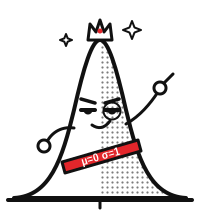
Parametric school · Normy's wayInfers specific population parameters like μ or σ². Assumes a population shape (usually normal) and often equal variances; usually needs interval or ratio data. Most powerful when the assumptions hold, but it can mislead when they don't, especially with small samples.
Nonparametric school · Sensei's wayOften called distribution-free: it doesn't assume a normal population. It often tests medians or whole distributions using ranks or signs, works with ordinal (even nominal) data, and resists skew and outliers.
Still assumedRandom sampling and independent observations. Nonparametric means fewer assumptions, not zero.
The trade-offIf the data really are normal, a nonparametric test is a little less powerful. Wilcoxon vs the t-test: ARE = 3/π ≈ 0.955.
When to go nonparametricRanks or ordinal data, a small n, doubtful normality, or outliers you can't (and shouldn't) delete.
A little historyArbuthnot's sign test (1710) → Wilcoxon's rank tests (1945) → Mann–Whitney (1947) → today's computer-heavy methods like the bootstrap.
START THE MISSIONS
MISSION 1 OF 5

Methodology faceoff

+10 XP
HOW TO PLAY
  1. Each line describes a trait of a method.
  2. Decide whether it belongs to parametric or nonparametric methods.
  3. Pick for every trait.
CLEARS WHENall 5 traits are matched.
Q1Assumes a specific population distribution, like normal
Q2Often works on ranks or signs
Q3Tests claims about parameters like μ and σ²
Q4Happy with ordinal data
Q5Also known as “distribution-free”
0/5 CORRECT

ALL MISSIONS IN THIS EPISODE